Sitting in the Unknown with Baku
.jpg)
Baku is a Quebec-based digital artist whose hyperrealist work explores the liminal space between presence and absence, emergence and disappearance.
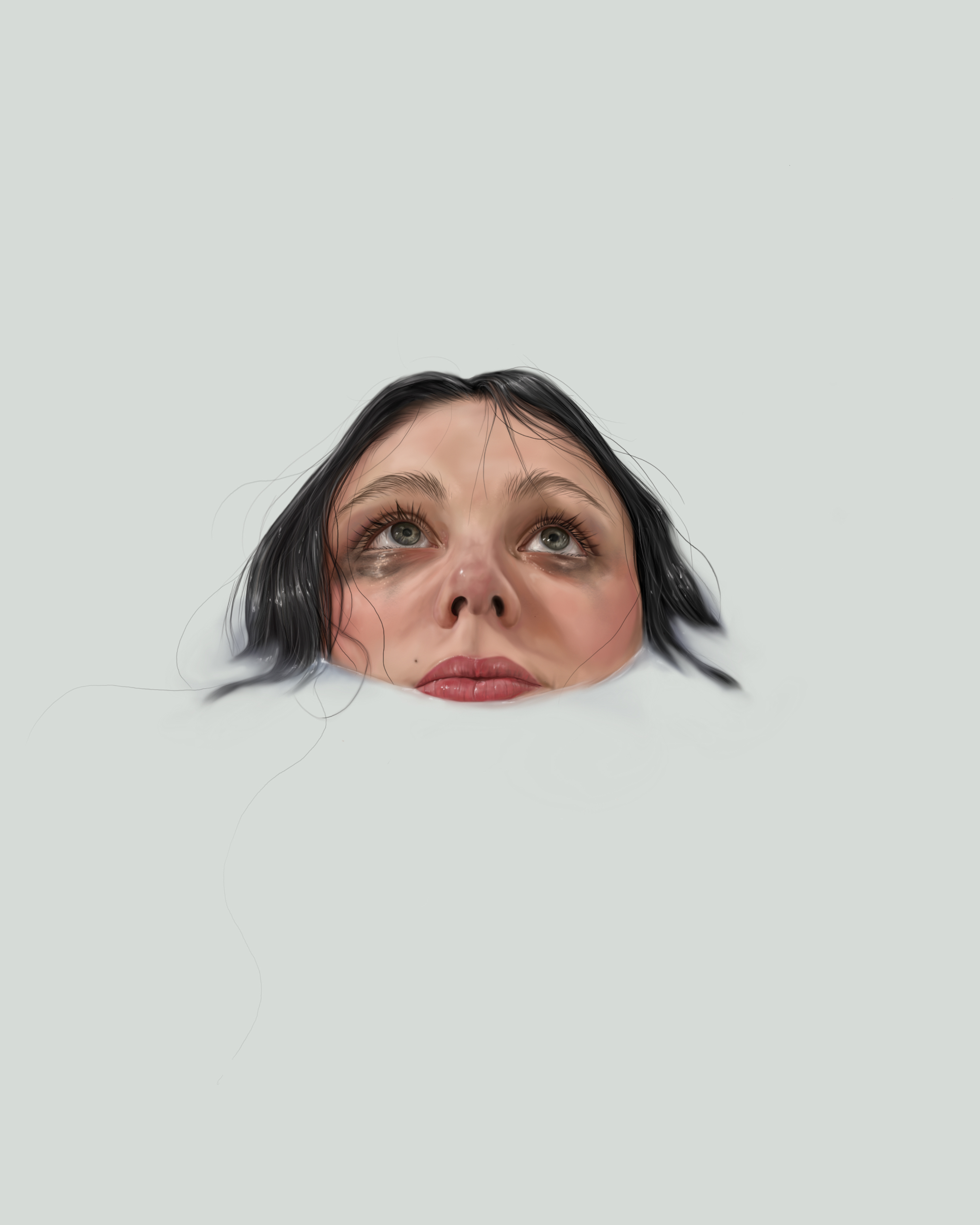
Her portraits are studies in suspension. Solitary figures float in vast, empty space — stripped of context, untethered from ground or sky. They exist in a state of in-between and ask you to stay with what's unresolved.
What makes Baku's practice distinctive is her commitment to ambiguity as a generative space. She's not looking to provide answers or clear narratives. Instead, her work functions as a point of entry and an invitation to bring your own interpretation, emotions, and memories to what you're seeing. The figures intend to make room for you to feel.
Her path to this visual language wasn't linear. She started with oil painting, moved into abstract work with resin pouring, then returned to figurative practice before transitioning entirely into digital painting. Each phase taught her something different, and those lessons remain embedded in how she works today. Even though she paints digitally, her approach is rooted in the patience and precision of traditional painting: observation, layering, and building depth through attention to detail.
Baku's work has been seen all across the world. It's been featured on hundreds of digital billboards, exhibited in galleries internationally, and collected as both physical prints and NFTs. But for years, the work was personal and internal, something she made because she needed to make it. Now, seeing people connect with what she's created has shifted everything. The work is no longer just hers.
Her belief that contemplation is becoming increasingly important in how we engage with art drives her practice. And that slowing down, staying with something unresolved, is where meaning actually forms.
What would you like people to know when they first come across your artworks?
When people first come across my work, I don’t expect them to immediately understand it. What matters more to me is that they take a moment to stay with it.
I think contemplation is becoming increasingly important in the way we engage with art. We often move quickly, looking for something immediate or easy to understand, but art asks for the opposite. It asks for time, for a slower kind of attention.
When I create a piece, I’m not trying to provide answers. I’m more interested in opening questions. The works are intentionally ambiguous, existing in a space between two states, between emerging and sinking, between presence and disappearance.
There’s a certain beauty in that in-between, in not knowing, in staying with something unresolved instead of trying to define it too quickly. I think that space allows for a more personal connection, because each viewer brings their own interpretation, emotions, and memories.
For me, the artwork is not a conclusion, but a point of entry.
When thinking about where you are in your journey, are you most excited about and what keeps you inspired for the future?
Where I am in my journey right now feels really exciting. For a long time, I was creating without any real transactions or external validation. It was something very personal. Now, seeing people connect with my work, engage with it, and respond to it changes everything. It feels like the work is no longer just mine, it begins to live in other people’s minds.
What inspires me for the future is the sense that I’m still evolving. There is always more to learn, more to refine, and more to understand about my own artistic language. I don’t see it as something fixed, but as something that keeps shifting as I grow.
I’m also excited by the idea of being more present with my work as it moves through the world. It has already been exhibited in many places, which I’m very grateful for, but I haven’t always had the chance to travel with it. I’m interested in experiencing that more directly, being there and seeing how people respond in different contexts and cultures.

If you could go to dinner with any artist, who would it be and why?
It might sound cliché, but I would have loved to meet Edvard Munch. Growing up, art wasn’t really something my surroundings paid much attention to. It was seen more as something like crafting, rather than a way to express something deeper.
The first time I saw The Scream, I was quite young, and I remember feeling an immediate connection. It wasn’t about understanding it intellectually, it felt more like recognizing something I already carried but didn’t know how to express. That moment made me realize that art could communicate something internal, something difficult to put into words.
I think I would simply want to thank him for that. For that moment of recognition and for opening the door to a different way of seeing and creating.
What is the best piece of advice you've been given?
The best advice I’ve been given is to practice every day. It came from one of my old oil painting teachers, and it has stayed with me ever since.
It sounds simple, but I think it’s the most honest way to improve. There’s no real shortcut when it comes to developing your eye and your technique. Showing up consistently is what sharpens your sense of observation, and over time, it naturally refines the way you work.
For me, it’s not about producing something perfect every day, but about staying in that process. Even small studies or unfinished pieces contribute to something bigger. It builds a kind of sensitivity, where you start noticing things you wouldn’t have seen before, because for me, hyperrealism is really a practice of attention to detail.
I think this discipline is what allows the work to evolve. It’s really about showing up, again and again, over time.

What is one thing you wish you'd be asked in an interview?
I wish people asked me why the void feels so present in my work. It’s often perceived as emptiness, but for me, it’s not an absence. It’s an active space.
The void is where most of the tension lives. It’s not just a background, it shapes the way the figure exists. Without a defined environment, the subject becomes less anchored, more fragile, but also more open. It allows the work to exist in a space that is not fully defined, where something can emerge or disappear at the same time.
This probably comes from the landscapes I grew up with in Québec. The winter, the endless white horizons, the silence. Those environments feel vast and disorienting, but also very present. I think that stayed with me.
The void creates a space for projection. It invites the viewer to stay with the image a bit longer, without giving them a clear direction. It’s where the work remains unresolved, and for me, that’s where it becomes most alive.
How has your practice evolved over time?
My practice has evolved quite a lot over time. I started with oil painting, then moved into abstract art with resin pouring, before returning to figurative work and eventually transitioning into digital painting.
Each phase taught me something different, and I still carry those lessons into my current practice. Even though I now work digitally, my approach remains deeply influenced by oil painting, especially in terms of observation, layering, and attention to detail.
I’ve gone through a long period of exploration, trying different styles and directions without always knowing where it would lead. Over time, my relationship to my practice has shifted. I’ve become more disciplined, more rigorous, and more intentional in the way I work.
What feels different now is that I have a clearer visual language. There’s a stronger sense of identity in what I create. It didn’t happen all at once, but through years of experimentation, refinement, and consistency.
What music are you listening to these days?
Lately, I’ve been listening to a mix of Angine de Poitrine, Feist, Yin Yin, and Glass Beams.

Did you always know you wanted to be an artist? If so, was there a particular moment that gave you the confidence to start sharing your work with the world?
No, I didn’t always know I wanted to be an artist. Even though art was always present in my life, I grew up in the countryside of Québec, where career paths often feel limited, and choosing a non-traditional path isn’t always fully understood. There was a certain weight to that, especially coming from family expectations, so I didn’t really see it as a real option for myself.
I have to admit, I felt a bit lost for a while. I moved to Sherbrooke to study philosophy, and that’s when things started to shift. I met my partner at the time, who was working in an art gallery, and he really encouraged me to take my practice seriously and to share my work.
That encounter was significant for me. It gave me the confidence to see art not just as something personal, but as something that could exist in the world. Looking back, it was a turning point that changed the direction of my life, and ultimately what led me to start sharing my work.


